

Computational systems biology
Ohno Project
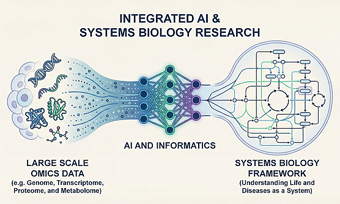
A diverse array of molecules—including DNA, RNA, proteins, and small-molecule compounds—interact inside cells and construct a vast and highly precise system. In multicellular organisms, homeostasis is maintained by a complex network of these cells, tissues, and organs, and the disturbance of this system is the essence of diseases. While earlier studies have primarily focused on individual molecules, recent technological innovations have accelerated the acquisition of comprehensive, large-scale omics data, encompassing the genome, transcriptome, proteome, and metabolome.
Today, the rapid advancement of artificial intelligence (AI) technologies, particularly deep learning, is bringing dramatic transformations not only to fields like image recognition and natural language generation but also to the life sciences, as best exemplified by 3D protein structure prediction tools like AlphaFold. However, while general AI excels at capturing statistical correlations within data, it does not necessarily reflect the underlying biological mechanisms.
We aim to develop a new mathematical framework for understanding the fundamental nature of living systems using large-scale data. By integrating the powerful predictive capabilities of AI with the logical principles of systems biology, we are advancing the development of highly versatile computational technologies.
Research Project
Development of novel mathematical frameworks to decode mechanisms from large-scale data and predict biological phenomena
Satoshi Ohno, Ph.D. (Associate Professor, TARA Center)
Currently, we are particularly focused on intracellular metabolism, developing original methodologies centered on deep learning and multi-omics integration.
1) Single-cell metabolic modeling
2) Mechanism-based multi-omics integration
3) Spatiotemporal understanding of pathological systems
4) Development of diagnostic and predictive AI using medical data

